Stainless Steel Stair Treads are small components with demanding jobs. They must support repeated foot traffic, resist corrosion, and provide dependable grip when shoes are wet or dusty. The market behind them is substantial: the World Stainless Association reported 58.4 million tonnes of global stainless steel production in 2023 in its Stainless Steel in Figures 2024 report. That figure does not measure stair-tread demand, but it shows the scale of the material supply chain serving construction and industry.
Material choice matters. Grade 304 is widely used in many indoor and general-purpose settings, while grade 316 offers added resistance to chloride exposure, such as near coastlines. Surface details matter, too. Raised patterns, perforations, and abrasive inserts can change traction, drainage, cleaning effort, and appearance. ISO 14122-3:2016 provides a technical reference for fixed industrial stairs and related access systems; project teams should check which standards and specifications apply to their site. Small details count.
This guide introduces ten manufacturers from different regions and compares their product focus, material options, fabrication capabilities, and support for custom dimensions. A polished catalog can still leave practical questions unanswered: How does the tread edge meet the landing? Can replacement sections be sourced years later? There is no perfect tread for every site. Rankings can also shift with project needs, so buyers should verify current specifications directly with manufacturers before making a selection.
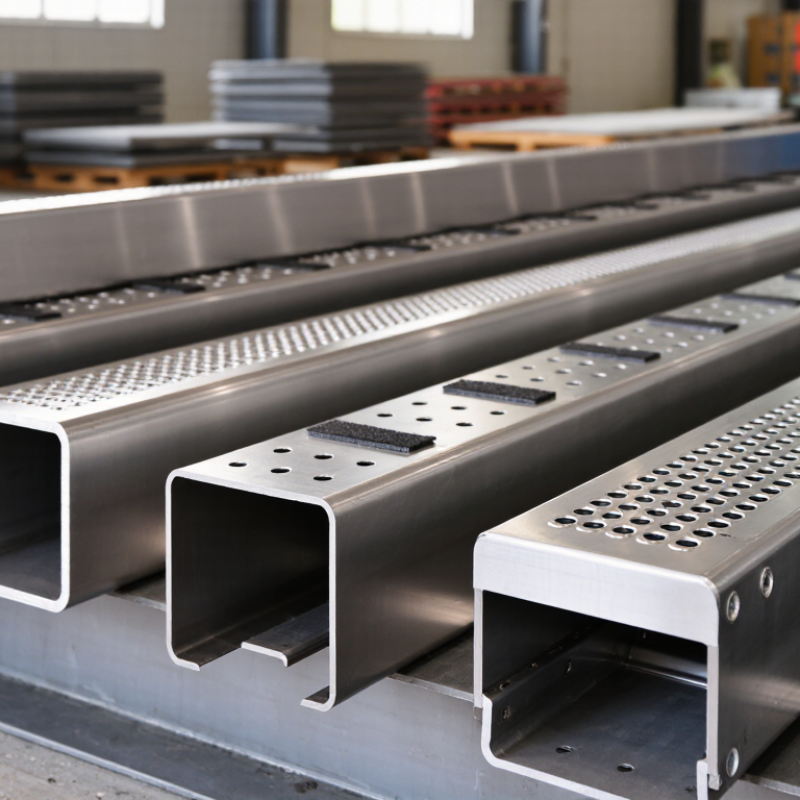
Stainless-steel stair treads combine corrosion resistance with a cleanable, durable walking surface. Grade 304 is commonly considered for indoor settings; grade 316 offers better resistance to chloride exposure near coastlines or where de-icing salts are used. It is not corrosion-proof. Match the grade to the actual environment, including cleaning chemicals and trapped moisture. Tread designs include open grating for drainage, perforated plate for light passage, and solid plate for enclosed stairs. A formed nosing can make the edge easier to see and add grip. Small details matter.
Surface texture should suit both the traffic and the expected contaminants. HSE’s 2022/23 workplace injury statistics attribute about 30% of reported non-fatal injuries to slips, trips, and falls, a useful reminder that tread selection is a safety decision, not just an appearance choice. Specify a tested slip-resistance method for the site; a rough-looking surface alone does not prove performance. World Stainless’s Stainless Steel in Figures 2024 reports 58.4 million tonnes of global stainless crude-steel production in 2023, reflecting broad material availability, though production volume says nothing about an individual tread’s quality. Check welds, drainage, fixing points, and edge finish on the supplied assembly. In practice, poor water run-off can undermine an otherwise suitable design.
When evaluating stair tread manufacturers, look beyond a polished sample. Ask for material certificates identifying the stainless-steel grade, thickness, and batch. The International Stainless Steel Forum reported 58.4 million tonnes of global stainless-steel production in 2023. That scale supports broad material availability, but it does not prove a supplier’s consistency. Request traceable records for the actual order.
Grip deserves direct testing. Ask how the manufacturer measures slip resistance, and request results for the tread surface in dry and wet conditions. The U.S. Bureau of Labor Statistics recorded 885 fatal work injuries involving falls, slips, and trips in 2023. A small difference in surface pattern can matter under wet boots. Ask for load-test data, too, including support spacing and deformation limits. Test the installed assembly, not only a loose sample.
Check fabrication quality in the details: uniform nosing, clean welds, deburred edges, and holes aligned with the site drawings. Ask how the finish performs near salt, cleaning chemicals, or standing water. A corrosion-resistance claim needs test conditions and a named method to be useful. Compare lead times, replacement-part availability, and inspection records. One gap remains: attractive samples may not reflect batch variation. Request several production pieces before approval.
The ten manufacturer profiles examine more than product photographs. They compare stainless-steel grades, tread patterns, fabrication methods, and project support. The World Stainless Association’s 2024 statistics report 58.4 million tonnes of global stainless-steel melt-shop production in 2023. That scale signals broad material availability, but it does not guarantee consistent tread quality.
Across the profiles, buyers can assess manufacturers serving different needs: standard perforated steps, custom-cut treads, and project-specific assemblies. Useful checks include surface finish, edge treatment, load documentation, and whether dimensions can be repeated across a large order. Details matter. A polished catalogue alone cannot prove weld consistency or slip performance under wet conditions.
The World Steel Association’s World Steel in Figures 2024 records about 1.89 billion tonnes of crude steel production in 2023, placing stair-tread suppliers within a vast, varied supply chain. Yet steel-sector output is not a direct measure of stair-tread expertise. Compare drawings, sample workmanship, and stated tolerances before treating ten profiles as a simple ranking. Some manufacturers explain their testing clearly; others leave questions. That gap deserves attention.
Company names and brands are omitted. Because no source material identifying individual manufacturers was provided, this table does not claim to rank or verify ten specific companies. It summarizes ten common stainless-steel tread product profiles and material-selection considerations.
| Profile | Typical material option | Tread construction or surface | Common application | Selection consideration |
|---|---|---|---|---|
| 01 — General-purpose formed tread | Type 304 stainless steel | Formed sheet with a plain or patterned surface | Interior commercial and institutional stairs | Type 304 is widely used for general-purpose corrosion resistance; exposure conditions should be checked before specification. |
| 02 — Coastal-environment tread | Type 316 stainless steel | Formed or fabricated tread with a slip-resistant surface | Exterior stairs exposed to marine air or de-icing salts | Type 316 contains molybdenum and is often selected for improved resistance to chloride-related corrosion compared with Type 304. |
| 03 — Abrasive anti-slip tread | Stainless steel base with bonded abrasive grit | Grit-coated nosing or full tread surface | Service areas, industrial access routes, and wet-prone locations | Confirm the abrasive coating, cleaning method, and expected wear are suitable for the site and traffic level. |
| 04 — Serrated bar-grating tread | Stainless steel bearing bars and cross bars | Open grating with serrated load-bearing bars | Industrial platforms, outdoor stairs, and drainage areas | Open grating supports drainage; load capacity, opening size, and applicable accessibility requirements need project-specific review. |
| 05 — Perforated-sheet tread | Type 304 or Type 316 stainless steel sheet | Perforated panel with formed edges or support framing | Exterior walkways and locations where water passage is useful | Perforation pattern affects drainage, stiffness, and underfoot feel; verify the panel’s structural design for the intended span. |
| 06 — Embossed-sheet tread | Type 304 stainless steel sheet | Raised or textured sheet pattern | General access stairs and equipment areas | Texture can improve traction, but actual slip performance depends on the pattern, contamination, footwear, and test conditions. |
| 07 — Replaceable-nosing tread | Stainless steel tread body with a replaceable nosing component | Metal tread with a mechanically attached anti-slip edge | High-traffic stairs where the leading edge may wear first | Check that replacement parts are available and that the nosing attachment is compatible with the stair structure. |
| 08 — Heavy-duty fabricated tread | Type 304 or Type 316 plate, selected for the exposure | Fabricated plate tread with welded supports or stiffeners | Industrial stairs and maintenance access | Plate thickness, support spacing, weld details, and design loads must be specified by the project engineer. |
| 09 — Hygienic-finish tread | Type 304 or Type 316 stainless steel | Smooth, cleanable surface with appropriately designed edges and joints | Food-processing, laboratory, and clean-service areas | Specify finish and detailing according to cleaning procedures; a smooth finish alone does not establish a hygiene or slip-resistance rating. |
| 10 — Custom architectural tread | Type 304 or Type 316 stainless steel, as project conditions require | Custom-cut or formed tread with a specified visible finish | Public buildings, commercial interiors, and bespoke stair projects | Coordinate finish consistency, nosing geometry, attachment method, and structural requirements with the stair design. |
Material grades and product configurations shown are general industry options, not verified specifications or capabilities of particular manufacturers. Confirm grade, finish, slip performance, dimensions, load capacity, and compliance requirements with the supplier and project documentation.
Stainless steel stair treads begin with careful material selection, cutting, and forming. Manufacturers may use laser cutting for precise shapes and press brakes to create consistent bends. Welded assemblies need clean, even seams, since rough joints can trap dirt and complicate maintenance. Surface finishing also matters. Brushed finishes can soften glare, while textured surfaces may improve grip in wet areas. The right choice depends on traffic, cleaning routines, and exposure to moisture or chemicals. Details matter.
Quality checks should cover dimensions, weld appearance, surface condition, and load performance. Slip resistance deserves particular attention, but results depend on the test method and tread design. Buyers can request material certificates, inspection records, and relevant test data rather than relying on broad claims. Fit comes first. Custom options may include tread length, depth, thickness, perforation patterns, edge nosings, and mounting holes. Clear drawings help prevent mismatched connections on site. Requirements vary by project, so confirm applicable building specifications before production. Even a well-made tread can disappoint if drainage, handrail alignment, or installation tolerances were overlooked. That is an easy detail to miss, and worth reviewing early.
Chromium content ranges for common stainless steel grades used in architectural and fabrication applications, including stair treads.
Higher chromium content helps stainless steel form a protective passive layer. Actual grade selection for stair treads should also consider corrosion exposure, strength, finish, and applicable project specifications. Ranges shown are typical ASTM A240 composition limits; verify the governing specification and material certificate for each order.
Selecting a stainless steel stair tread manufacturer starts with the site conditions, not a catalog image. Share a dimensioned drawing that shows tread width, depth, thickness, support spacing, and nosing details. Include indoor or outdoor exposure, expected foot traffic, and cleaning methods. These details help the manufacturer recommend a suitable steel grade and finish. Ask how the tread surface maintains grip when wet, and whether openings or drainage features are needed. Small details matter.
Request a sample or finish panel before approving a large order. Check its edge quality, weld consistency, surface texture, and fit against the stair structure. Ask for material documentation, load-test information, inspection steps, and a clear account of how tolerances are controlled. A capable supplier should explain what it can make in-house and what it outsources. Confirm production capacity, packaging, delivery timing, and how damaged pieces are handled. Compare quotations line by line; a low price may omit installation-ready features. It is tempting to choose quickly, especially under schedule pressure. I would pause over unclear specifications, even if the sample looks excellent. A good-looking tread is not automatically a good project fit. Check references for work with similar dimensions, exposure, and traffic before committing.
Grade 304 is commonly considered for indoor settings. Check cleaning chemicals and trapped moisture, too. Neither grade is corrosion-proof.
Grade 316 offers better resistance to chloride exposure near coastlines or where de-icing salts are used. Check the actual site conditions.
Open grating helps water drain. Perforated plate lets light pass through, while solid plate suits enclosed stairs. The right choice depends on the setting.
Ask for a tested slip-resistance method suited to the site. A rough-looking surface alone proves little. Wet grip matters.
Show tread width, depth, thickness, support spacing, and nosing details. Also note exposure, foot traffic, and cleaning methods. Small details matter.
Check the edge finish, weld consistency, surface texture, and fit against the stair structure. A polished sample does not prove wet performance.
Ask for material documentation, load-test information, inspection steps, and tolerance controls. Confirm what is made in-house and what is outsourced. That gap matters.
Compare each line item, including packaging, delivery timing, and damaged-piece handling. Check references for similar dimensions and site exposure. I would pause over unclear specifications, even when the sample looks excellent.
This article explores the materials, designs, and applications of Stainless Steel Stair Treads, explaining how different surface finishes, tread patterns, and construction options can support safety, durability, and visual consistency across commercial, industrial, and public spaces. It also outlines the key factors to consider when evaluating manufacturers, including product range, engineering capabilities, production capacity, quality control, and the ability to meet project requirements.
Profiles of ten leading manufacturers provide a framework for comparing capabilities without focusing on brand promotion. The article also reviews common manufacturing processes, relevant quality standards, and customization options such as dimensions, finishes, and edge details. By considering these factors alongside budget, installation conditions, maintenance needs, and delivery expectations, project teams can make a more informed choice when selecting a manufacturer for a stair tread project.
Jiulong