Engineered to ASTM A123, ISO 1461, and YB/T4001.1-2019 standards for extreme environmental durability and superior load-bearing capacity.
Understanding the Critical Role of Hot-Dip Galvanized (HDG) Steel Grating in Modern Global Infrastructure
Hot-dip galvanizing produces an iron-zinc alloy coating that provides both barrier protection and cathodic (sacrificial) protection. Under ASTM A123/ISO 1461 standards, hot-dip galvanized steel grating achieves a minimum zinc coating thickness of 85 µm (610 g/m²), delivering maintenance-free service life exceeding 50 years in C3-grade environments and 25+ years in aggressive marine C5 environments.
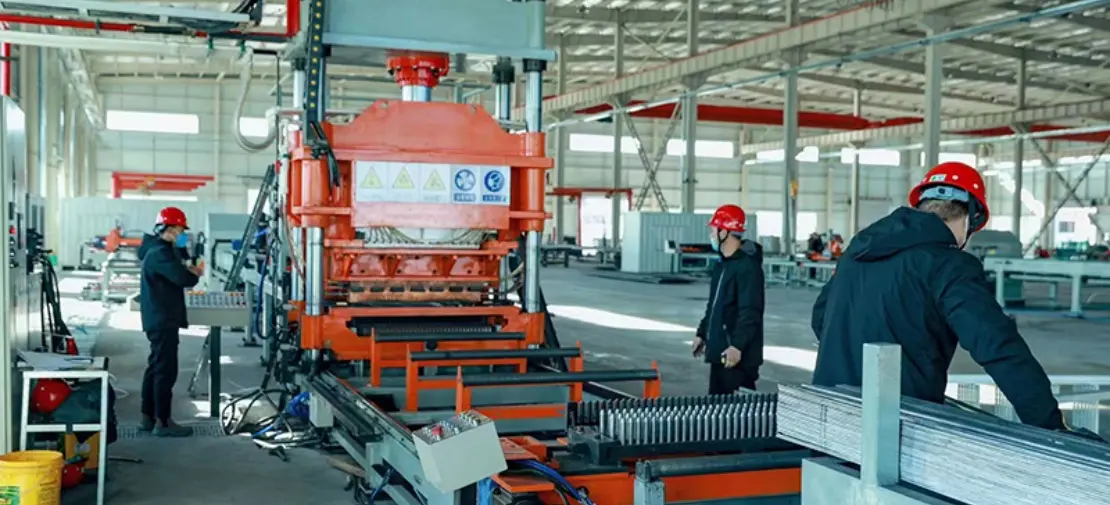
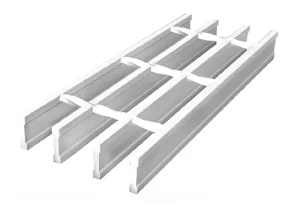
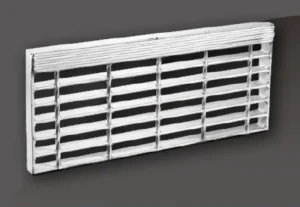
Through computer-controlled automated forge-welding, load-bearing flat bars and square twisted crossbars are fused under high hydraulic pressure (up to 200 metric tons) and high electrical current. This process yields a monolithic grid structure that maximizes ultimate load capacity while reducing structural dead-weight by 30% to 50% compared to solid steel plating.
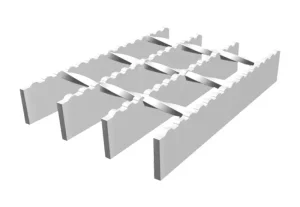
Open grid design facilitates optimal air circulation, natural light penetration, and rapid liquid drainage, preventing accumulation of explosive gases, water, ice, or hazardous chemical spills. Serrated surface profiles comply with international anti-slip safety standards (e.g., DIN 51130 R11-R13 ratings), significantly reducing slip-and-fall hazards in oily processing environments.
Technical Insight for EPC Contractors: Choosing forge-welded steel grating manufactured to YB/T4001.1-2019 or ANSI/NAAMM MBG 531 ensures strict tolerances on pitch dimensions, crossbar alignment, and diagonal squareness, eliminating costly on-site modification delays during platform erection.
Pioneering World-Class Steel Grating Fabrication Since 1993
Founded in 1993, Ningbo Jiulong Machinery Manufacturing Co., Ltd (NJMM) stands as a premier global leader in the engineering, design, and manufacturing of hot-dip galvanized steel grating, industrial handrail pipe systems, drainage trench covers, structural platforms, and light steel fabrication structures. As a modern comprehensive enterprise integrating scientific research, digital manufacturing, and engineering installation support, NJMM operates across global industrial markets.
NJMM maintains two expansive production bases strategically located in the East and North of China. Spanning a total facility footprint of over 450,000 square meters (with workshop areas exceeding 30,000 square meters), NJMM operates 12 state-of-the-art automatic pressure welding product lines, 6 sets of fully automated robotic banding workstations, and 2 specialized irregular grating fabrication platforms.
NJMM participated directly in drafting and revising China's national steel grating standard YB/T4001 in 2019. Recognized as a national High-Tech Enterprise, Municipal Engineering Center, and certified Green Factory, NJMM embodies precision engineering through laser cutting, digital control panel tailoring, and automated robotic MIG welding.
Our quality management systems fully comply with international rigorous standards. NJMM holds ISO9001:2015 Quality Management System Certification, ISO14001:2015 Environmental Management Certification, ISO45001:2018 Occupational Health & Safety Certification, CE Certification (EN 1090 structural steel), and GOST Certification for Eurasian markets.
NJMM exports over 20,000 metric tons of steel grating products annually to South America, Europe, Oceania, Africa, West Asia, Southeast Asia, and the Middle East. Our proprietary brand "Longta" is specified across megaprojects worldwide in petrochemical plants, power generation stations, and municipal infrastructures.
Deep Metallurgical Insights, Load-Bearing Formulas, and Grating Design Standards
The hot-dip galvanizing process at NJMM involves a controlled multi-stage chemical and metallurgical reaction. Fabricated steel grating panels undergo degreasing, acid pickling (hydrochloric acid solution to remove mill scale and oxide layers), fluxing (zinc ammonium chloride), and preheating before immersion in a molten zinc bath held strictly at 445°C to 455°C (833°F to 851°F).
During immersion, a series of zinc-iron alloy layers are formed via solid-state interdiffusion between structural carbon steel (Q235B or S235JR) and molten zinc:
Steel grating designation follows standardized codes defining bearing bar depth, bar thickness, pitch spacing, and surface profile. Below is the structural matrix for primary industrial models:
| Grating Model | Bearing Bar Size (mm) | Bearing Bar Pitch (mm) | Crossbar Pitch (mm) | Safe Load Uniform (kN/m²) [2m Span] | Primary Industrial Application |
|---|---|---|---|---|---|
| JG255/30/100 | 25 x 5 | 30 | 100 | 14.2 kN/m² | Light Pedestrian Platforms & Walkways |
| JG325/30/100 | 32 x 5 | 30 | 100 | 23.5 kN/m² | General Industrial Platforms, Refineries |
| JG405/30/100 | 40 x 5 | 30 | 100 | 36.8 kN/m² | Heavy Walkways, Power Station Boiler Structures |
| G505/30/100 | 50 x 5 | 30 | 100 | 57.5 kN/m² | Heavy Machinery Platforms & Port Logistics |
| JG705/30/100 | 70 x 5 | 30 | 100 | 112.0 kN/m² | Heavy Drainage Trenches & Mining Infrastructure |
| JG806/30/100 | 80 x 6 | 30 | 100 | 180.4 kN/m² | Vehicular Traffic (H20 Heavy Truck Loading) |
| JG1008/30/100 | 100 x 8 | 30 | 100 | 320.0 kN/m² | Extra Heavy Duty Mining & Port Terminals |
According to YB/T4001.1 and ANSI/NAAMM MBG 531, structural deflection of steel grating platforms under maximum working load must not exceed L/200 of the clear span (or a maximum of 10 mm for comfortable pedestrian movement). The maximum allowable bending stress ($\sigma$) is calculated using standard elastic beam theory:
Bending Moment Formula (Uniform Load): $M_{max} = \frac{W \cdot L^2}{8}$
Bending Moment Formula (Center Line Load): $M_{max} = \frac{P \cdot L}{4}$
Where $W$ = uniform load, $P$ = concentrated line load, and $L$ = clear span length between structural steel beam supports.
Engineered Platforms and Flooring Systems Tailored for Extreme Operating Conditions
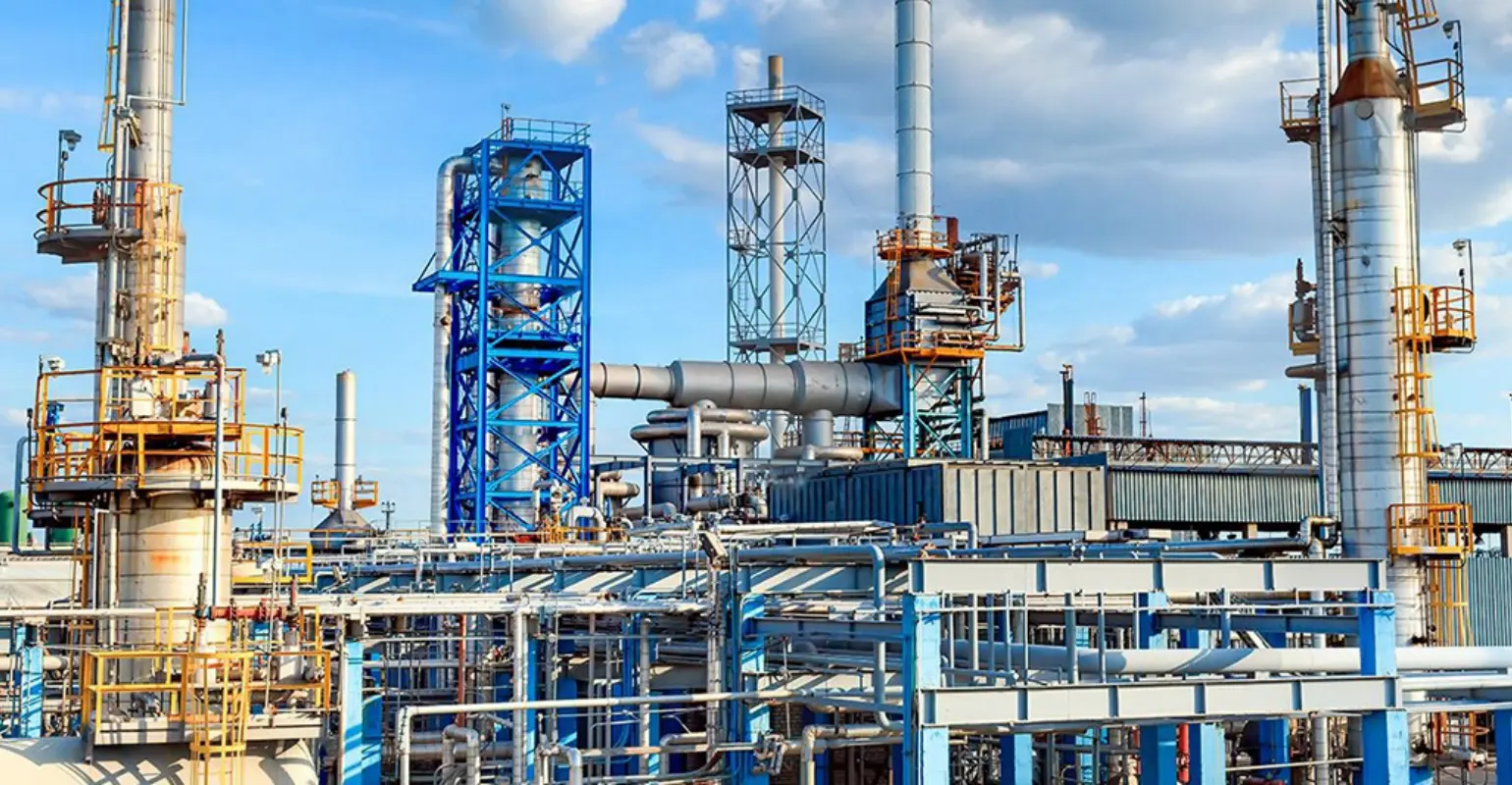
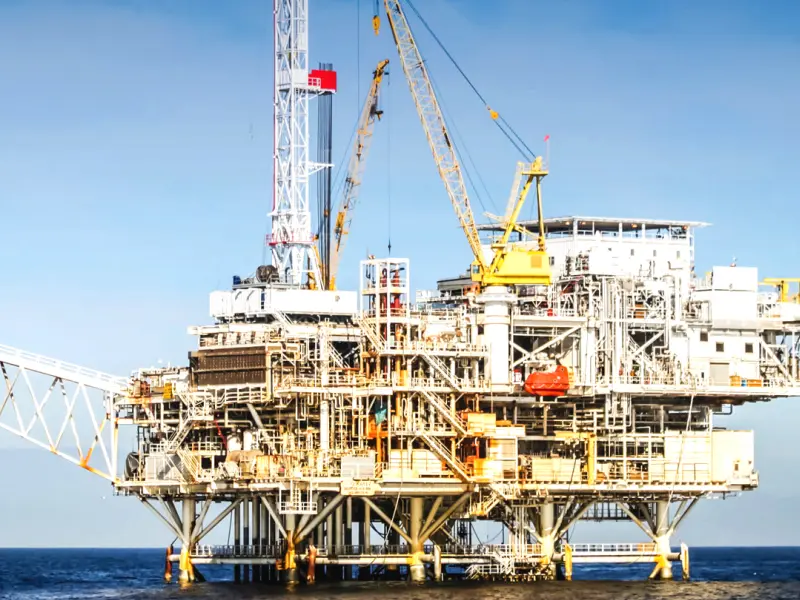
Oil refineries, offshore rigs, and chemical processing facilities demand non-sparking, chemical-resistant walkway grating. High ambient humidity, airborne hydrocarbons, and corrosive vapors require serrated forge-welded steel grating (e.g., JG325/30/100, JG405/30/100) with heavy hot-dip galvanizing coating (minimum 85 µm to 100 µm thickness).
Key Performance Advantages:
Container yards, mining haulage roads, and naval shipyards handle extreme point loads from forklifts, gantry cranes, and heavy trucks. NJMM manufactures heavy-duty trench drain covers and solid steel grating (e.g., G505/30/100, JG806/30/100, JG1008/30/100) specifically designed to absorb dynamic impact forces.
Key Performance Advantages:
Thermal power stations, nuclear facilities, wind turbine platforms, and modern waste-to-energy plants utilize NJMM steel grating for multi-story operating floors, boiler structure catwalks, stair tower treads (models JT1 to JT8), and ventilation louvers.
Key Performance Advantages:
Ensuring 100% Traceability and Quality Assurance from Billets to Finished Grating
All structural steel flat bars are manufactured from prime Q235B / S235JR carbon steel with full Mill Test Certificates (MTC) according to EN 10204 3.1. Chemical composition (Carbon, Manganese, Silicon, Phosphorus, Sulfur) is strictly verified to guarantee optimal forge-welding ductility and galvanizing reaction speed.
Automated pressure-welded joints undergo routine shear-strength pull testing to confirm complete molecular fusion between crossbars and bearing bars. Zinc coating thickness is measured across 10 random points per panel using calibrated magnetic coating thickness gauges per ISO 2178.
NJMM maintains continuous audit compliance for ISO9001, ISO14001, and ISO45001. Our factory production control (FPC) system for CE marking meets EN 1090-1 execution class EXC2, permitting seamless distribution across European Economic Area (EEA) markets.





Advancing Smart Fabrication, Green Metallurgy, and Digital BIM Integration
NJMM is actively deploying AI-guided robotic trimming and vision-assisted automatic welding stations. By integrating real-time laser measurement sensors onto pressure-welding lines, pitch accuracy tolerance is maintained within ±0.2 mm, accelerating custom cut-out panel production for complex industrial plant geometries.
Recognized as an official municipal "Green Factory", NJMM continues to pioneer closed-loop acid recovery systems, waste heat recovery from natural gas kettle furnaces, and zero-VOC flux formulations. Our zinc kettles utilize high-velocity pulse combustion burners to minimize carbon intensity per metric ton of steel processed.
To support major EPC clients utilizing Tekla Structures and Revit, NJMM provides 3D BIM parametric grating models. Engineering consultancy teams directly import panel layout drawings, automated shop nesting files, and load-calculation models into master plant digital twins, drastically reducing design lead times.
Expert Engineering Guidance on Steel Grating Selection, Specification, and Maintenance
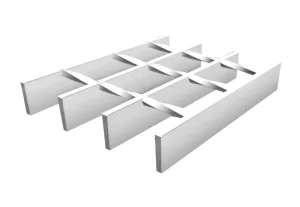
Plain type steel grating features smooth-surfaced flat bearing bars, offering lower friction coefficient, easy cleanability, and cost efficiency for standard indoor walkways. Serrated type steel grating features deep notch grooves along the upper bearing bar edge, providing superior slip resistance (Class R11 to R13) essential for greasy, icy, or sloped outdoor oil platform catwalks.
Hot-dip galvanizing (HDG) forms a metallurgically bonded zinc-iron alloy coating typically exceeding 85 µm (610 g/m²), offering sacrificial cathodic protection and 30-50 years of service life. Electro-galvanizing yields a micro-thin coating (5-12 µm) suitable only for light indoor applications. Anti-rust paint lacks sacrificial corrosion capability and chips easily under heavy foot or vehicular traffic.
Bearing bar dimensions depend directly on clear span distance and required design load (uniform live load vs. concentrated wheel load). For instance, a 1,000 mm span supporting standard pedestrian traffic (3.0 kN/m²) requires a JG255/30/100 panel. Heavy truck traffic (H20 load) over a 1,500 mm span demands heavy-duty panels like JG806/30/100 or JG1008/30/100. Our engineering office provides customized span deflection calculations.
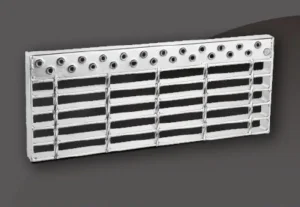
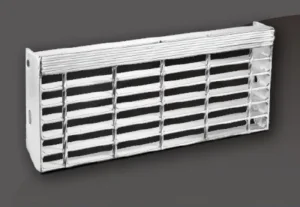
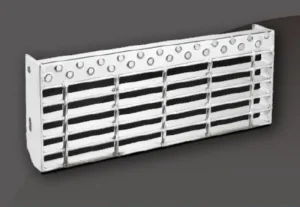
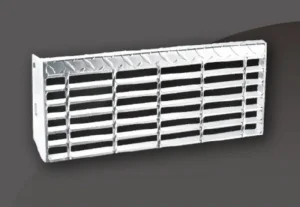
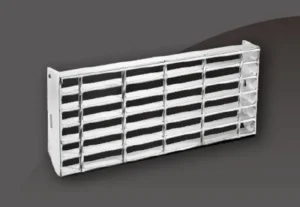
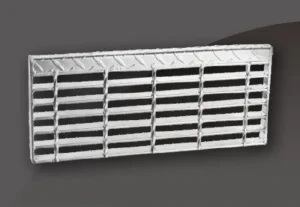
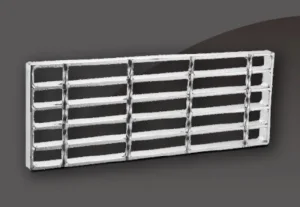
NJMM offers 8 standardized stair tread designs: JT1 (welded mounting, plain nosing), JT2 (bolted mounting, plain nosing), JT3 (welded mounting, checkered plate nosing), JT4 (bolted mounting, checkered plate nosing), JT5 (welded mounting, slip-resistant strip nosing), JT6 (bolted mounting, slip-resistant strip nosing), JT7 (welded mounting, perforated slip-resistant nosing), and JT8 (bolted mounting, perforated slip-resistant nosing).
Panels are secured using either direct field tack welding (minimum 20 mm weld length per corner) or saddle installation clips (Type A, B, or C clips). Installation clips allow secure fastening without damaging protective zinc coatings or requiring hot-work permits in live chemical processing facilities.
NJMM products comply with major global standards, including YB/T4001.1-2019 (China), ANSI/NAAMM MBG 531 (USA), BS4592 (UK), AS1657 (Australia), and DIN 24537-1 (Germany). Hot-dip galvanizing complies with ASTM A123 / ISO 1461.
Explore Our Precision-Engineered Stair Tread Series and Specialized Structural Elements
 Jiulong